

Living together comes with a quiet promise: the home is both people’s job. Then real life shows up. Friends stay longer than expected on a rainy afternoon, and by the time they leave, the living room looks like a small event happened: cups on the coffee table, blankets in a pile, reusable bags by the door, and crumbs on the floor. Nobody is angry. You are both just tired. The only real question is who starts — and why it always has to become a conversation.

A household task app for couples cannot stop the rain or hurry the guests out. But it can take the guesswork out of the moment after: who owns the reset, when it gets done, and where the plan lives instead of in one person’s head.

When home life starts living in one person’s head

The problem is rarely a single messy living room. It is the invisible list that keeps growing: groceries, laundry, dishes, bins, the plant, the hallway thing. When that list lives in one person’s memory, every shared moment comes with a quiet tax:

  • One person notices what needs doing and carries it around all day.
  • “Did you do the thing?” slowly replaces normal conversation.
  • Work that happens unseen might as well not have happened.
  • The same tasks get rediscovered every single week, like they are brand new.

The result is a low hum that one person is holding more of the home than the other sees. That hum is the mental load — and it is what a shared household plan should absorb.

How the shared household task loop works

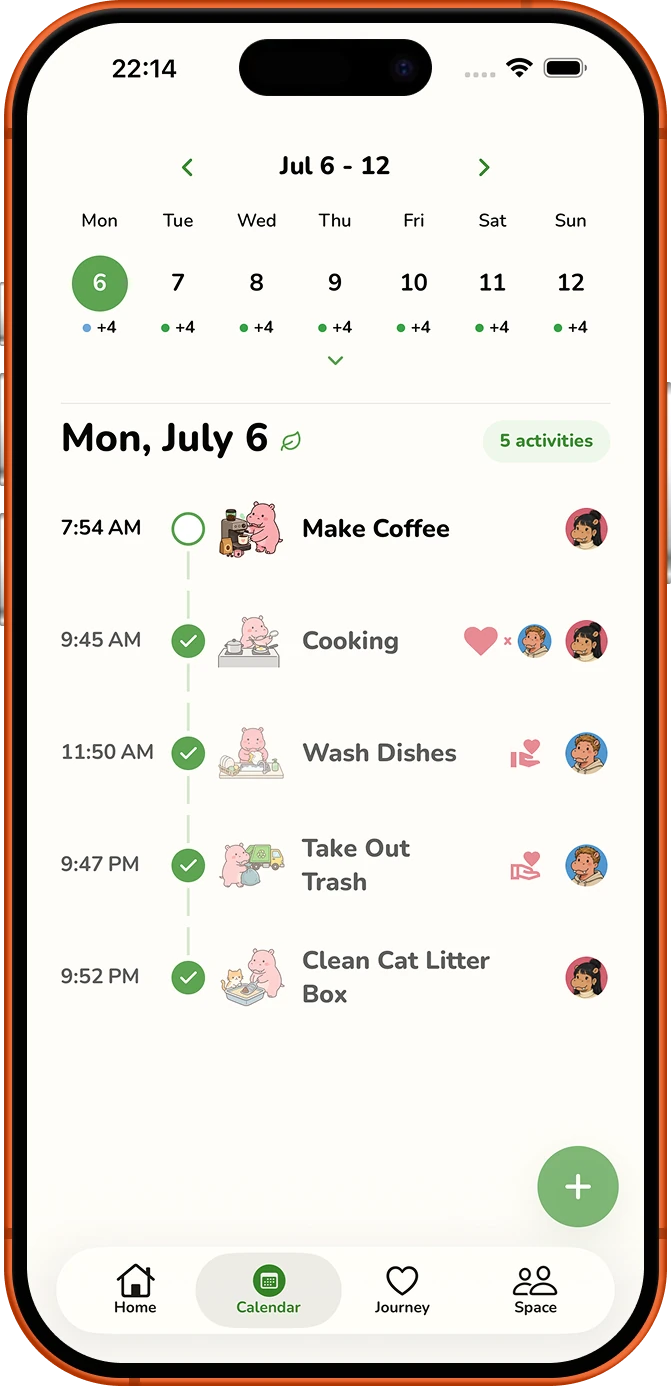
Roxily gives a couple one shared Space where the whole loop lives:

  • One Space for the home. Both people see the same plan. Nothing waits in a private list or a forgotten note.
  • Clear ownership. Every Activity has a responsible person, so “I thought you had it” stops being a plot twist.
  • Recurring tasks and rotation. Weekly and monthly work can repeat on its own, or rotate between you, so the routine never needs to be rebuilt from scratch.
  • Visible completion. When something is done, it stays done on screen. Effort gets seen while it is still fresh.
  • Lighter mental load. Nobody has to hold the whole picture in their head anymore. The Space holds it.

The loop is simple: plan it, own it, do it, see it. The plan does the remembering; you get the credit.

A rainy Sunday reset, handled by the plan

Picture a rainy Sunday. Two friends stayed longer than expected, and by the time they leave, the living room looks like a calm storm passed through: three cups on the table, the sofa buried under blankets, reusable bags waiting by the door, and a light dusting of snack crumbs on the floor.

You are both tired. The old version of this moment goes one of two ways: one person quietly starts cleaning while feeling resentful, or one person asks “so… the living room?” and the evening turns into a negotiation about fairness.

The Roxily version: the after-guest reset is already an Activity in the shared Space. It belongs to whichever partner handles the reset this week, and it repeats after every get-together. Both of you can see that. So one person gathers the cups and the reusable bags, folds the blankets back into their corner, and does a quick sweep while the other opens the windows. No speech required.

By the time the floor is clean, the Activity is marked done and both of you see it. One person got a real break. The other got seen without having to ask. The shared plan turned a potential mood into twenty quiet minutes, and the relationship lost nothing.

Why a note or a group chat is not enough

A note on the fridge can hold a list, and a chat thread can hold a promise. Neither can show ownership, completion, or the pattern over time. Notes go stale. Messages sink. And when the plan lives in a chat, every reminder becomes a personal message that has to be worded carefully.

Roxily keeps the plan somewhere neutral. The Space holds the task, the owner, the schedule, and the history in one place. You are not asking your partner to remember anything — you are both checking the same shared picture. That feels different from texting “hey, cups?” after a long day.

Who this works well for

Roxily fits couples and roommates who want home life to stop depending on one person’s memory — especially when you both care but notice different things or work on different schedules. It is also useful for homes with frequent guests, pets, or routines that shift.

It is not built for managing employees, running a cleaning business, or turning your relationship into a chore chart with a report card. A household app should lighten home life, not grade it.

Frequently asked questions

Do we need to set everything up perfectly from day one?

No. Start with the one recurring task that creates the most friction — the after-guest reset, the bins, the laundry — and let the plan grow from there. Roxily does not demand a complete system on day one.

Can a task repeat on its own or rotate between us?

Yes. You can make an Activity recurring and give it flexible ownership or rotation, so the week does not have to be rebuilt from scratch every time.

Will this turn our home into a scoreboard?

No. Roxily shows completed work so effort gets seen, but it does not judge, rank, or total up who did more. The plan is for clarity, not competition.

What if we both forget to open the app?

That is the point: the plan is the backstop. When ownership, recurrence, and completion live in one shared place, forgetting stops costing the other person their whole evening.

Does it work for roommates, or only couples?

It works for any small shared home. Couples are the main focus, but roommates and other two-person households use the same Space, ownership, and rotation.

Let the plan hold the home

The best household task app quietly disappears into your routine. You still do the work and live your life, but nobody has to be the family brain. The person who gathered the cups and swept gets seen without having to ask.

Download Roxily on the App Store · Get Roxily on Google Play